

Heat interface units (HIUs) are compact, wall-mounted appliances that connect individual apartments or properties to a centralised heat network or district heating system.
Installed in place of traditional boilers, HIUs use plate heat exchangers to transfer heat from the primary network into each dwelling's heating system and domestic hot water supply, providing instant heating and hot water on demand without the need for a gas supply.
Heat interface units eliminate individual boilers in apartment blocks, reducing capital costs, maintenance requirements, and carbon emissions whilst enabling accurate heat metering and fair billing for residents.
Our heat pump optimised MTA Plus Twin passed the 2023 BESA HIU Test, with 7 Best Practices Achieved.


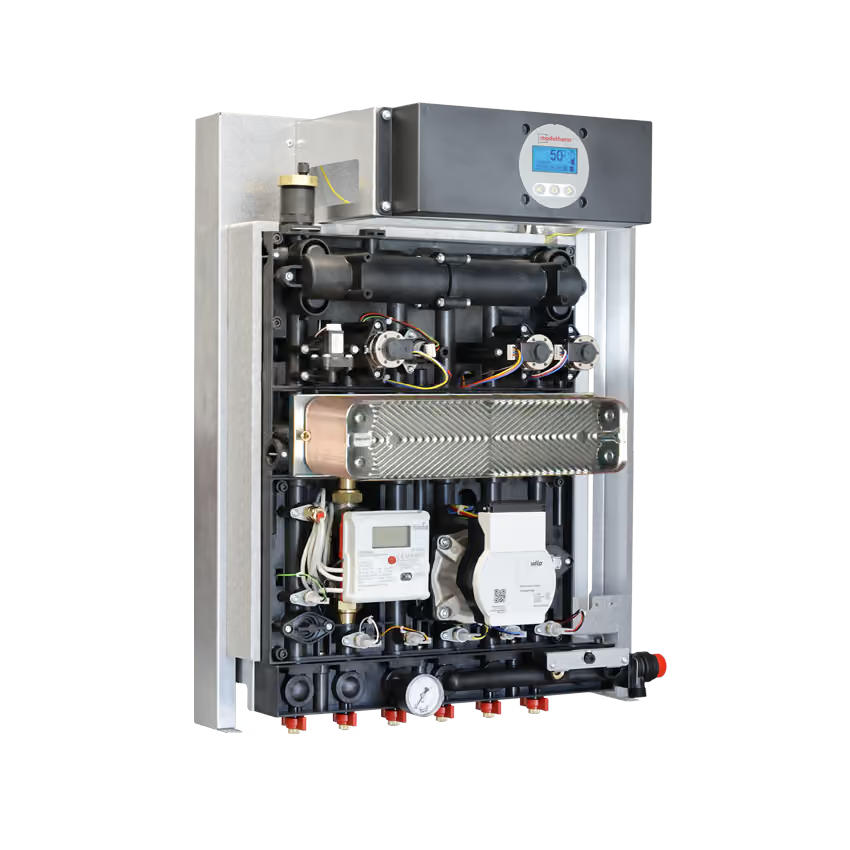


Modutherm's MTA range covers seven models across indirect twin plate, direct heating, DHW-only, and stored hot water configurations, with primary pressure ratings from 3 to 16 bar to suit low-rise apartments through to high-rise developments.
| MTA Plus | MTA Eco | MTA Plus | MTA Eco | MTA Eco | MTA Plus | MTA Eco | |
|---|---|---|---|---|---|---|---|
| Twin | Twin | Single | Single | Twin Zone | DHW | DHW | |
| Type | Indirect heating & DHW | Indirect heating & DHW | Direct Heating / Indirect DHW | Direct Heating / Indirect DHW | Indirect heating & optional stored hot water | Indirect DHW | Indirect DHW |
| Maximum Heating Capacity | 27 kW | 21 kW | 19 kW | 19 kW | 23 kW | - | - |
| Maximum DHW Capacity | 107 kW | 90 kW | 107 kW | 90 kW | - | 107 kW | 90 kW |
| Maximum Operating Pressure | 16 bar | 16 bar | 3 bar | 3 bar | 10 bar | 10 bar | 10 bar |
| Differential Pressure (min/max) | 50 kPa / 400 kPa | ||||||
| Heat Exchanger | SWEP LAS AISI 316 heat exchangers | SWEP AS heat exchangers | SWEP LAS AISI 316 heat exchanger | SWEP AS heat exchanger | SWEP AS heat exchanger | SWEP LAS AISI 316 heat exchanger | SWEP AS heat exchanger |
| Heat Pump Optimised / Low Primary Flow And Return Temperatures | - | - | - | - | |||
The journey towards net zero in multi-residential apartments.

Heat Interface Units (HIUs) are the smart solution for modern district heating and communal heating systems, delivering exceptional value for developers, residents, and building managers in apartment blocks and multi-dwelling properties.
HIUs eliminate individual boilers in each flat, reducing capital costs and freeing up valuable space. With no gas supply infrastructure or flues required, construction is simpler and more cost-effective for apartment blocks and residential developments. At just 600 x 500 x 312mm, our MTA HIUs fit neatly into a cupboard. Centralised heating means one efficient plant room instead of servicing hundreds of individual boilers—ideal for social housing, student accommodation, and new build projects.
Residents enjoy instant domestic hot water (DHW) without waiting, plus precise space heating control for underfloor heating (30-45°C) or radiators (45-80°C). Our twin plate HIU design operates quietly with no combustion in dwellings—eliminating gas pipes and carbon monoxide risks. Advanced diagnostics with remote monitoring enable quick issue resolution, often without site visits.
District heating networks with HIUs enable efficient heat generation from combined heat and power (CHP), renewable sources, or heat recovery systems. Modern HIUs are specifically heat pump optimised for low temperature heat networks, ensuring exceptional return temperature performance for maximum efficiency and reduced operational costs. Our MTA Plus achieved the lowest VWART (Volume Weighted Average Return Temperature) scores in BESA testing—26°C (high) and 24°C (low)—confirming it as the UK's best performing heat interface unit for fourth-generation heat networks. As the grid transitions to renewable energy, your entire building benefits automatically.
Integrated heat metering ensures residents pay only for the energy they use, promoting fairness and energy-conscious behaviour in apartment complexes. Optional remote connectivity and building management system (BMS) integration provide real-time performance data for continuous heat network optimisation whilst reducing maintenance visits—perfect for managing communal heating across residential buildings.

Modutherm's MTA heat interface units are designed for use on communal and district heat networks, where a central energy source — whether a gas boiler, heat pump, or combined heat and power plant — distributes heated water to individual properties through a shared primary circuit. Installed in place of a traditional boiler in each apartment or dwelling, the HIU uses plate heat exchangers to transfer heat from the primary network into the property's heating and hot water systems, keeping the two circuits hydraulically separate. The MTA range supports heat networks operating across a wide range of primary temperatures, from high-temperature third-generation systems through to the lower-temperature fourth-generation networks increasingly associated with heat pump-led generation.
Modutherm's MTA heat interface units are well suited to prefabricated utility cupboard (PUC) configurations, where the HIU, pipework, and metering equipment are housed within a self-contained unit that can be installed quickly and consistently across multiple dwellings. PUCs simplify on-site installation, reduce time on site, and allow a greater degree of quality control compared to traditional in-situ builds. The MTA's ultra-compact dimensions and HydraBlok® backplate design make it particularly practical in this application, with all connections and serviceable components accessible from the front.
Contact us to discuss your project requirements.

The control panel within the MTA provides a user friendly, intuitive experience. In addition, it provides an extremely high level of real time data, offering an overview of the current conditions within the network, HIU and apartment.
These images show the MTA heat interface unit at various stages of production, from component assembly through to the finished appliance.
We pride ourselves on offering the very latest heat network technology, so we have created a bespoke HIU training course for installers. This includes:
Full demonstration of the installation process
Detailed explanation of key components
Hands-on demonstration of a fully functioning HIU alongside operational functions
Comprehensive review of controls interface
To book a training course, contact modutherm@modularhg.co.uk.
.jpeg)


